Multi-agent systems / orchestration / agent swarms
Agent Chimera
A sourced field guide to the engineering decision behind multi-agent AI: when a team of specialized agents is stronger than one agent, and when it is just a more expensive way to lose context.
The thesis
Multi-agent is a task shape, not a maturity badge.
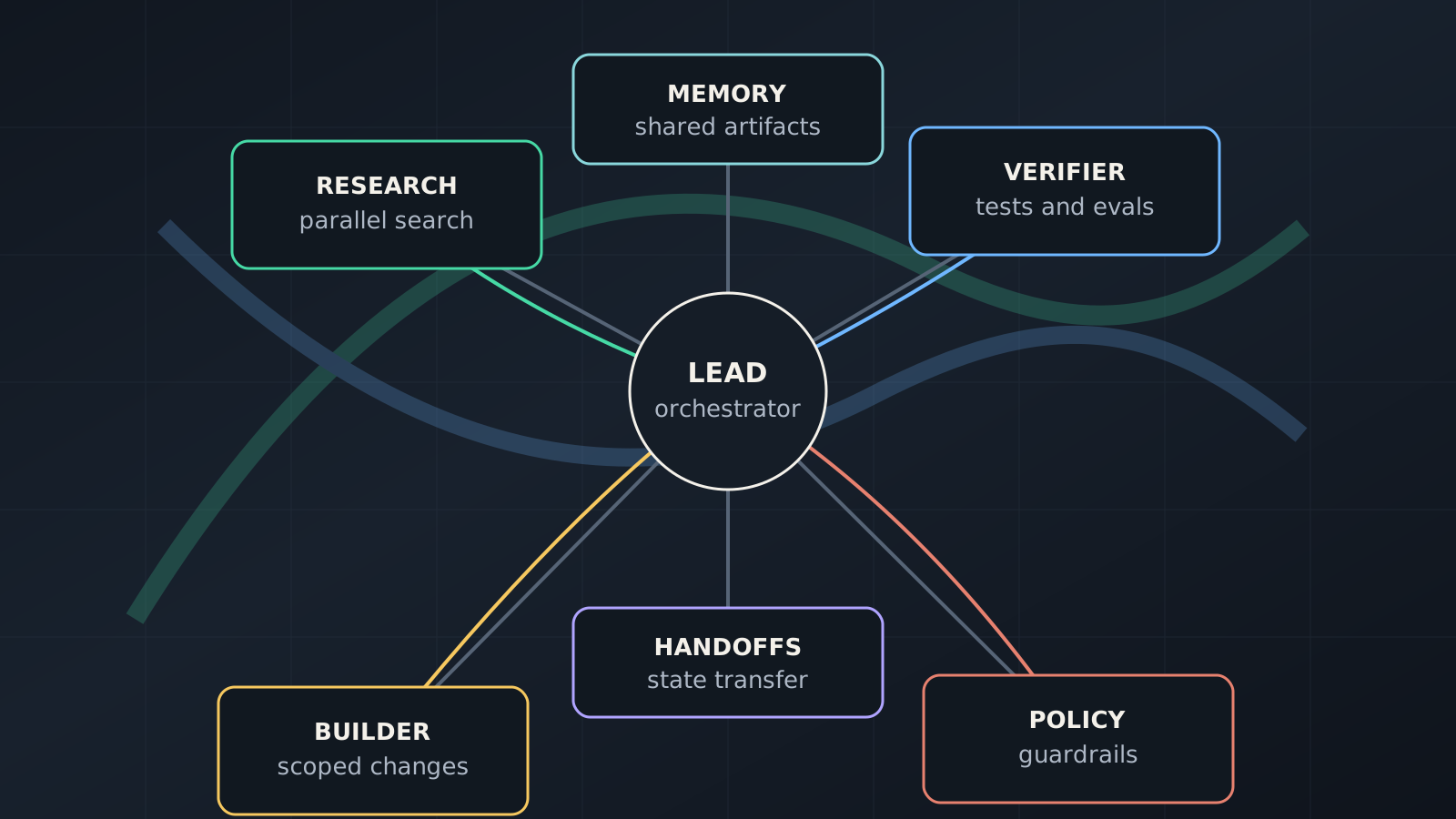
A multi-agent system is useful when separate agents can pursue different parts of a problem with their own context, tools, or evaluation criteria, then return artifacts that a coordinator can verify and synthesize.
That is why breadth-first research, independent review, translation across languages, and policy-separated handoffs are plausible fits. It is also why tightly coupled implementation work, small support flows, and high-risk actions often belong in one agent, a deterministic workflow, or a human approval loop.
"finding the simplest solution possible"
Free tools
Make the architecture call
Decision Quiz
Do You Need Multiple Agents?
Answer a short questionnaire and get a single-agent vs multi-agent verdict with a recommended orchestration pattern.
Pattern Picker
Agent Orchestration Pattern Picker
Rank orchestrator-worker, pipeline, debate, swarm, and judge-panel patterns against latency, cost, reliability, and task constraints.
Cost Estimator
Multi-Agent Cost Estimator
Estimate multi-agent run cost from agents, tokens, turns, model price, and coordination overhead, then compare it with a single-agent baseline.
Map
The field guide map
/tools
Tools
Free client-side tools for multi-agent architecture decisions.
/tools/do-you-need-multiple-agents
Do You Need Multiple Agents?
Answer a short questionnaire and get a single-agent vs multi-agent verdict with a recommended orchestration pattern.
/tools/pattern-picker
Agent Orchestration Pattern Picker
Rank orchestrator-worker, pipeline, debate, swarm, and judge-panel patterns against latency, cost, reliability, and task constraints.
/tools/cost-estimator
Multi-Agent Cost Estimator
Estimate multi-agent run cost from agents, tokens, turns, model price, and coordination overhead, then compare it with a single-agent baseline.
/single-vs-multi
Single vs Multi
When multiple agents help, and when one agent is better.
/patterns
Patterns
Orchestrator-worker, pipeline, debate, swarm, and hierarchy.
/coordination
Coordination
Shared memory, message passing, handoffs, and context isolation.
/failure-modes
Failure Modes
Cost blowup, error compounding, and context fragmentation.
/multi-agent-costs
Multi-Agent Costs
How to budget tokens, latency, and coordination overhead.
/worked-example
Worked Example
A concrete multi-agent build workflow.
/glossary
Glossary
Definitions for multi-agent orchestration terms.
/sources
Sources
Annotated primary sources used across the site.
/faq
FAQ
Frequently asked questions about multi-agent systems.
How to use this site
Start with single vs multi if you are making an architecture call. Use patterns when you already know a split is justified and need vocabulary. Use failure modes before you ship anything that lets agents call tools or hand work to one another.
Every page links back to primary sources and includes a "Cite this page" block. The stance is deliberately balanced: the same site that cites Anthropic's strong research result also keeps Cognition's context-fragmentation warning in view.